Chubby...Budai answers a question w/ a question
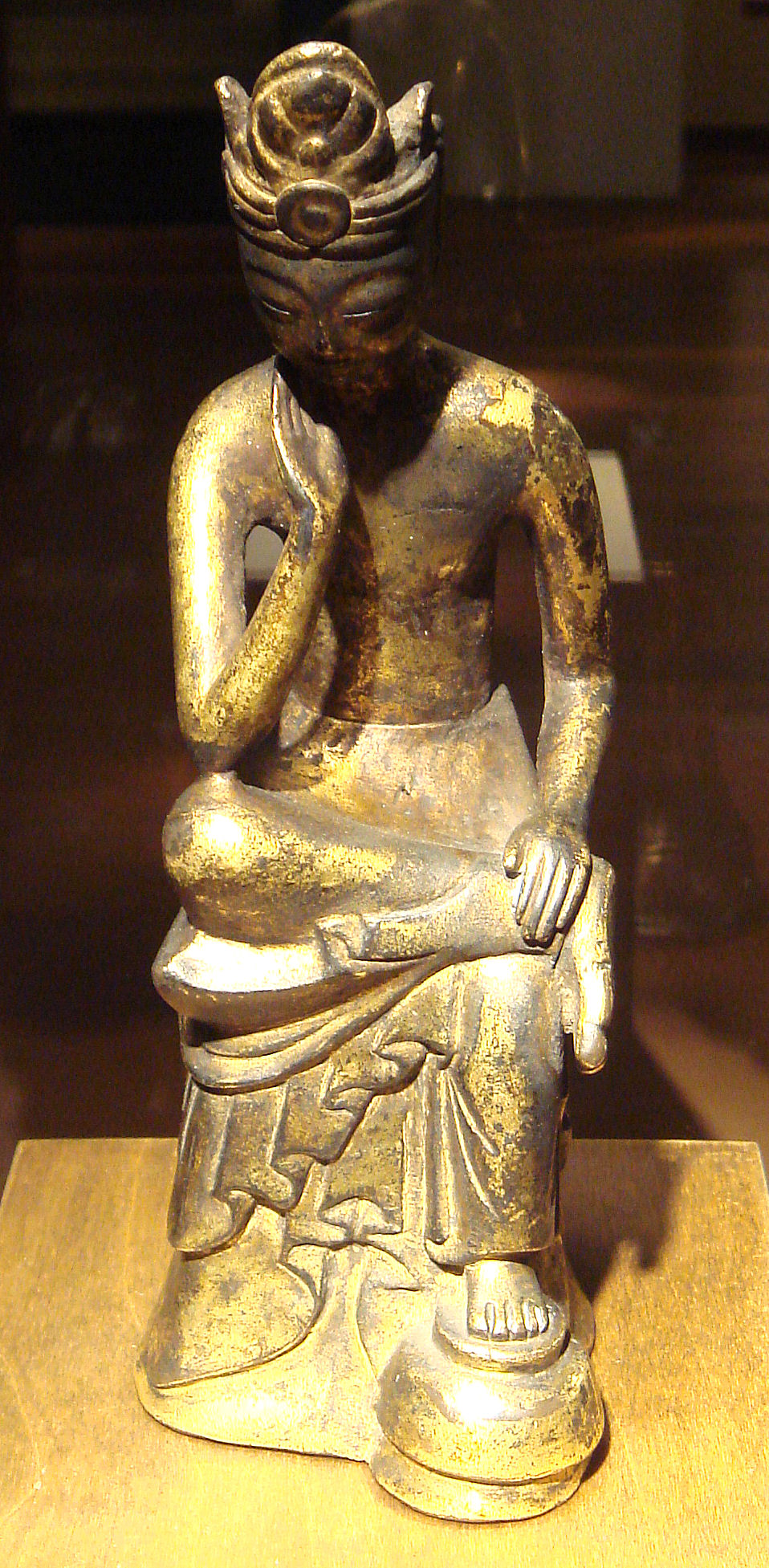
Among the problems I have struggled with in Buddhism, like many other organized forms of religion, is a dreadful seriousness and the bombastic claim to have found uppercase "T"-style TRUTH. All too frequently tenants of Buddhism and enlightenment are flogged as relentlessly as Christian Agape and Islamic Duty. No laughing, no seeking. Even the artwork can be unapproachable. Like this terribly serious Korean statue of "Maitreya". Maitreya is the wandering buddha or bodhisattva who is supposed to come in the future to bring enlightenment. But nowhere in any texts is he austere. His enlightenment doesn't make him aloof. In fact quite the opposite. He is supposed to be so comfortable with the pain of samsara and the other sufferings of the world that he's become a wandering saint throughout time. He's supposed to be the Laughing Buddha. Not the expensive, inaccessible, brooding statue next to the "water feature" in a Thai-fusion restaurant near DuPont Circle.
 I worry that American culture, particularly the costal, progressive cultures, have become far too image obsessed. This skinny, inward-looking, brooding buddha has slowly begun to replace the multitude of images we've had access to. Increasingly the images of an abstract, aloof, pan-ethnic buddha have become elitist in exactly the way for which costal progressive American culture is frequently criticized. And I think this is partially due to our obsession with body image. I'd frequently noted in the R.C. churches of my youth that the 'corpus' of Jesus, dangling on the cross, did have fantastic abs, glutes and biceps - tall, ectomorphic, almost Byronic. I was amazed in how similar the post-mortem portrait of Byron and the slightly-uncomfortably attractive crucified Jesus were. It seems that our Bodhisattvas, Messiahs and enlightened poets have to be young(ish), attractive and beyond a doubt never, never chubby. In art and in morality narratives, chubbiness is frequently portrayed as the opposite of enlightenment. Being engaged in the world, open and friendly is frequently portrayed as the opposite of the aloof enlightenment of contemporary buddhism. These images and narratives must be challenged. This narrowing of ideas must change.
As something of a disclosure, I myself am a chubby guy. I'm also pretty sociable and outgoing. Thus some of this polemic is in defense of the image I portray to others. I am writing in self-interest, to a lesser extent. I'd also like to point out that I know many chubby people who aren't affable and outgoing, and many affable and outgoing people who aren't chubby. But to a greater extent,
 I want to shatter social pre-conceived notions about who is more likely to achieve enlightenment and who is more likely to spend ten to twelve hours a week in a gym down the street from that hypothetical Thai-fusion restaurant. Some people will simply go to the restaurant and actually order the Pad-Thai, because it's not too fussy, and they haven't made a religion of body worship and carb-counting.
Buddhism was well-suited to most of Chinese culture. Daoism and Confucianism were receptive to many of the ideas that Buddhist travelers and monks brought into China. Among the archetypal figures that blended together was the Shinto wandering god Hotei, an eccentric 6th century Zen monk and the messianic 'next-buddha' Maitreya to form Budai the Laughing Buddha.

André Gide had once said, "Believe those who are seeking the truth. Doubt those who find it." One of the best parables about the chubby, laughing Buddha (or Budai) goes something like this. Budai always traveled with a big hemp/canvass/calico sack from which he gave small gifts and candy to the young and the young-at-heart. He also carries a little begging bowl asking for small donations for food. He became famous for being rotound and upbeat. He may also have been famous for a knack for catching dangerous snakes, de-fanging them, and letting them go. One day, while traveling another famous monk approached him and asked "What is the meaning of Zen?" Budai drops his bag to the ground suddenly, then asked the other famous monk, "How does somebody find Zen?" The other monk had a moment of inspiration. Budai picked up his bag and went on his way continuing to give candy to children, and begging for his own food.
 Budai seems to agree with André Gide. The best way to achieve enlightenment is to keep looking for it, and not assume that there is one single answer outside of time and space. Between the large sack filled with toys for kids, and the driving out of snakes, it would appear that both the Santa Claus and St. Patrick archetype are deep inside the laughing Buddha's belly. This image is tremendously popular in China, and occasionally popular in Japan. However, it's considered kitsch in most other parts of the world - and even by the costal progressives in China and Japan. And no doubt, through over-use this icon does become a worn-out cliché. But in a western (progressive costal) context it is ignored and dismissed so conclusively, that I believe there must believe there must be untapped power to it. I'm worried that we look down on this icon as dismissively as we do Santa Claus. We can't fathom the idea that a joyful tubby saint could have true enlightenment, or could be a true messiah. My worry is that the image of a byronic dead Jesus or an aloof skinny Buddha provide us with a single, æsthetically appealing answer, while chubby laughing Buddha instead asks us a question, challenges our contemporary assumptions to their very foundations...then gives us candy.
The reason for my fighting for the image of the laughing Buddha is that images are very, very powerful. We do not live in an iconoclastic society or religion (sometimes the Muslims come close), and therefore we need to be very, very careful with the images we make of messiahs and buddhas. Too much of our day-to-day cultural hang-ups and assumptions can get coded into our images or the transcendent and of divine beauty. This both cheapens the visions of later viewers, and can emotionally cathect unskilled viewers onto physical forms which lead them away from clear thinking and enlightenment.
This laughing Buddha brings a sense of humor to the essential absurdity of life (particularly our techno-obsessed corporate/consumer culture) and shows that generosity and a positive outlook combined with good-natured questioning is a powerful way towards both personal enlightenment and building a better world for others.

2 Comments:
Your chubby daughter has finally embraced that the 'laughing buddha' by the door is not crying and tickles him when she enters the house. Tickling Buddai seems like a very reverent gesture.
Santa Claus as Buddai! It fits perfectly. I wonder why I never saw it before.
Santa wanders through space and time. He gives everything away (toys and candy). He has no apparent attachment to the material. He is large and laughing! He is an icon of strength and sanity in an absurd world; of course, by behaving in an absurd way.
I, personally, reject the skinny, aloof Buddha. The Budai is much more appealing to me. I feel that the happy, "life is but a dream" buddha has a better grip on reality. He doesn't care about image. Each life is only what is is. The definitions of culture only mask the true human mission; which is to create a social order, large or small, that provides an environment of security for the opportunity of growth.
I'm so glad that I now see Santa for what he is: a fat happy Budia.
Post a Comment
<< Home